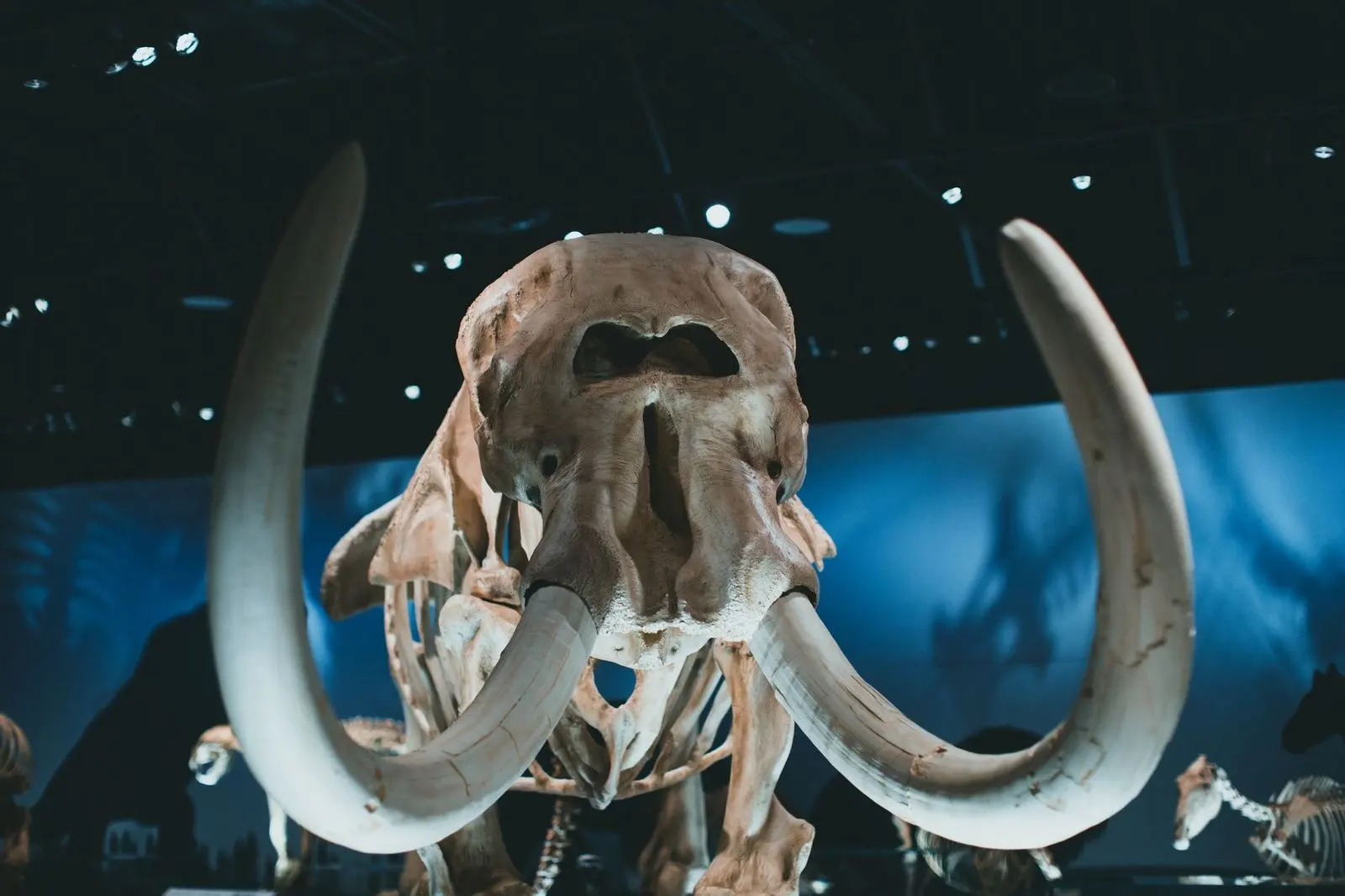
If you’re curious about ice age animals that went extinct, the short answer is that mammoths, giant sloths and moas vanished mostly after humans arrived. Climate probably played a smaller part, though scientists still debate it.
This guide is part of our wider look at extinct animals, and it focuses on the big mammals and birds lost at the end of the last ice age.
| Item | Value |
|---|---|
| Megaherbivores (≥1,000 kg) that survived to the present | 11 out of 57 species |
| Megafauna genera lost in the late Quaternary | About 65% (vertebrates above 40 kg) |
| Window in which most losses fall | About 50,000 years |
| Australia: time from human arrival to megafauna disappearance | About 13,500 years |
| Length of the debate over the causes | Over 200 years |
These figures come from a Cambridge Prisms: Extinction review and a peer-reviewed study of Australian fossils. Estimates change as dating and fossil records improve, so check the sources before you rely on them.
Which large animals disappeared at the end of the ice age?
Researchers who focused on the last 100,000 years found that many of the world’s biggest land animals vanished. A University of Cambridge news release on a PNAS study of land animals weighing 44 kg or larger names some of the best-known casualties, listed below. The release is the source for all of them.
- Mammoths in North America and Eurasia
- Mastodons and giant sloths in the Americas
- The woolly rhino in Europe
- Giant kangaroos and wombats in Australia
- Moas, the giant flightless birds of New Zealand
Those animals are examples, not the full list. The Cambridge Prisms review notes that other groups also suffered, mainly large non-mammalian vertebrates and smaller species tied to megafauna, as set out in the review’s abstract.

The scale and shape of the losses
The size bias is what makes this event unusual. According to the Cambridge Prisms review, it stands apart from other Cenozoic extinctions, a span covering the last 66 million years, in how strongly it targeted large bodies.
Among megaherbivores of 1,000 kg or more, only 11 out of 57 species survived to the present, per the same review. Another study estimates that about 65% of megafauna genera were lost, with megafauna defined there as large vertebrates above 40 kg, according to the Australian fossil study.
Most of the extinctions fell inside the last 50,000 years, mainly in the Late Pleistocene and the Early to Middle Holocene. The review also reports that the losses varied among continents in severity and date, yet hit every biome, from the Arctic to the tropics (source).
For wider context on extinction events across Earth’s history, see our guide to the five mass extinctions.
What the evidence says about humans
Several lines of research point toward people. A global analysis of large mammal species of 10 kg or more found that extinction severity was strongly tied to hominin (human and close-relative) palaeobiogeography, with at most a weak, Eurasia-specific link to climate change. Its authors call this strong support for modern humans as the primary driver of worldwide megafauna losses, as reported in the Royal Society B paper.
In Australia, a study of 659 fossil ages estimated that the megafauna disappeared about 13,500 years after humans arrived, with shorter overlap in some regions. The same team found the extinctions were broadly synchronous among genera and independent of climate aridity and variability (study).
A review in Cambridge Prisms: Extinction concludes that the evidence strongly supports a dominant role for Homo sapiens, as laid out in its open-access text. It adds that the debate has run for over 200 years, intensifying from the 1960s onward, according to the abstract.
Could climate change explain it?
Probably not on its own. That review reports little support for any major influence of climate, in either global extinction patterns or fine-scale evidence (source).
Not every study says humans acted alone. A University of Cambridge news release describes a study that concluded a combination of human arrival, probably through hunting or habitat alteration, and climate change caused the extinctions (news release).
A separate hypothesis argues that the end of the ice age changed the rules for big animals. In that account, many of the advantages of being large were either lost or became disadvantages, leaving species more exposed to threats such as human predation, competition and habitat loss, as outlined in the Biological Reviews paper.
Put together, the sources disagree less about whether humans mattered than about how much weight to give climate. That is why careful summaries say “strong support” rather than “proven”.
Why the loss still matters
The effects did not stop with the animals themselves. A broad range of evidence indicates profound changes to ecosystem structure and functioning, according to the Cambridge Prisms review.
Today’s large animals face related pressures. The Cambridge team said its findings bear on tigers, polar bears, elephants and rhinos, and warned that many large animals are threatened by both hunting pressure and changes in climate (news release).
For a closer look at one famous animal, read about what killed the saber-toothed tiger.
Frequently asked questions
What counts as megafauna?
Show answer
There is no single cutoff, and studies use different weight limits. One analysis counted large vertebrates above 40 kg (Australian fossil study), while another review defined terrestrial megafauna as mammals above 45 kg (Biological Reviews paper).
Did people hunt every species to extinction?
Show answer
Not necessarily. The Cambridge team pointed to hunting or habitat alteration, and another hypothesis lists predation, competition and habitat loss as threats that hit species already made vulnerable (news release, Biological Reviews). The exact cause may differ from one animal to the next.
Are large animals still at risk today?
Show answer
Yes, according to the Cambridge researchers, who said many big, charismatic animals now face hunting and climate pressure. Without action, they warned, further extinctions could follow (news release).
Is the cause settled?
Show answer
Not entirely. Most current work grants modern humans at least a contributory role, yet the topic is still described as controversial in the open-access review.