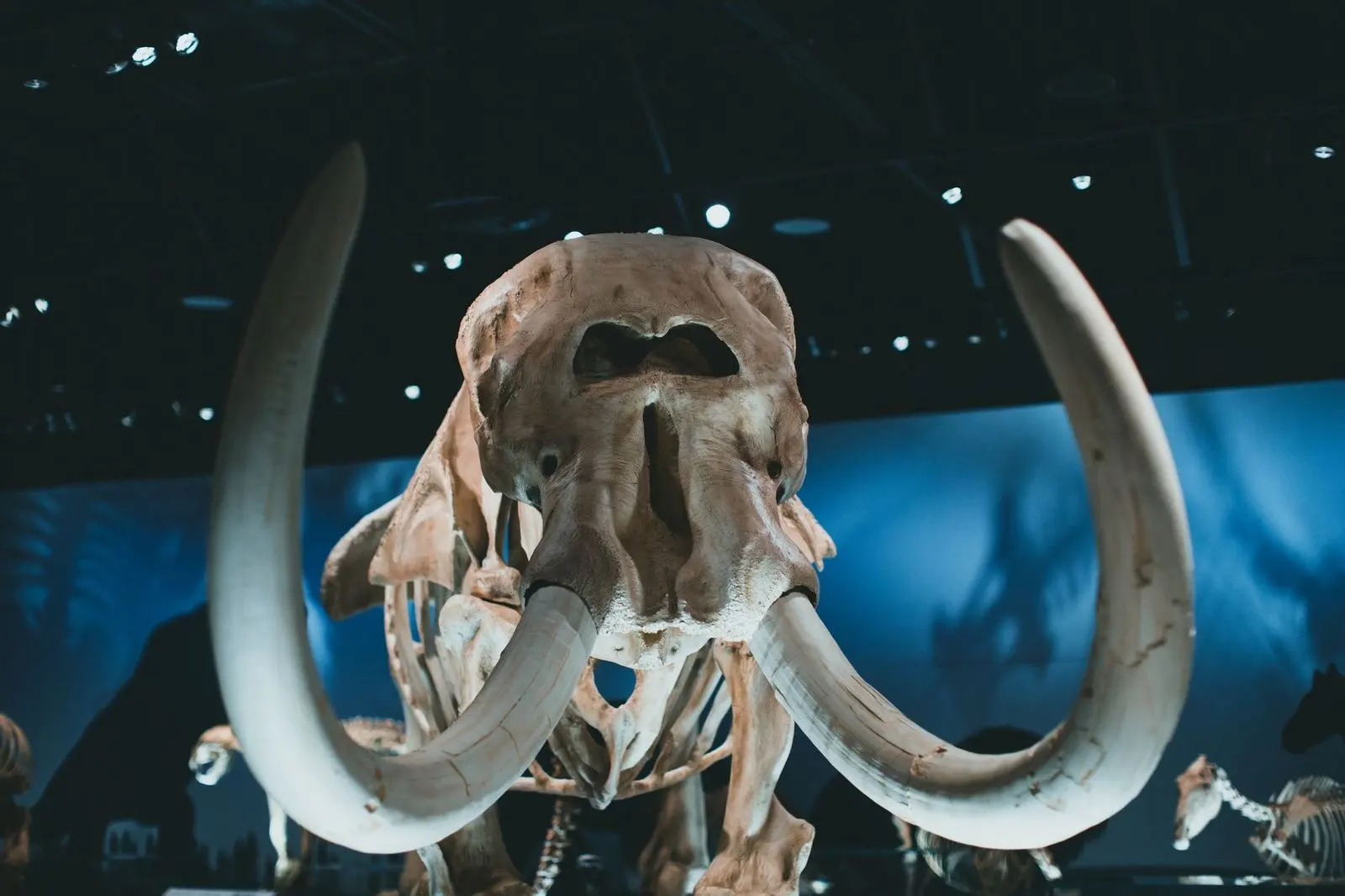
If you have ever wondered how close life came to ending, here is the answer. The five mass extinctions were planet-wide species collapses, mostly driven by volcanoes and climate shifts, and the last one ended the non-avian dinosaurs.
Each of these events shaped the animals you will meet in our wider guide to extinct animals.
| Extinction event | When and how much was lost |
|---|---|
| End Ordovician | 444 million years ago; 86% of species lost |
| Late Devonian | 360 million years ago; 75% of species lost |
| End Permian | 250 million years ago; 96% of species lost |
| End Triassic | 200 million years ago; 80% of species lost |
| End Cretaceous | 65 million years ago; 76% of species lost |
The table follows Our World in Data’s overview of the Big Five. Dates and percentages are estimates that researchers revise over time, so check the source before you rely on them.
What counts as a mass extinction?
Extinction is a normal part of evolution, so a mass extinction has to be something much bigger. Our World in Data describes a natural background rate, and ordinary stretches of Earth history lose species at roughly this pace:
- 10% of species lost every million years (Our World in Data)
- 30% of species lost every 10 million years (Our World in Data)
- 65% of species lost every 100 million years (Our World in Data)
Even that background rate is never zero: it was typically less than 5 families per million years, according to the same article.
A mass extinction is a spike far above that baseline. By Our World in Data’s definition, at least 75% of species go extinct within a geologically short window, typically less than two million years. Scientific American sets its bar a little lower, at 70 percent or more of the species living at the time.
The count of five reaches back at least 500 million years. Little is known about extinction events in the Precambrian and early Cambrian, which come before that, Our World in Data notes.
The Ordovician and Devonian extinctions
End Ordovician
The earliest of the Big Five came at the close of the Ordovician, 444 million years ago. Our World in Data puts the loss at 86% of species, while National Geographic gives an estimate of 85 percent.
Massive glaciation locked up huge amounts of water in ice, and sea levels plummeted by hundreds of feet. The chill may have been triggered by the rise of the Appalachian Mountains, whose freshly uplifted rock weathered and pulled carbon dioxide out of the atmosphere.
The hardest toll fell on marine life, according to National Geographic, including:
- corals
- shelled brachiopods
- eel-like conodonts
- trilobites
Late Devonian
The Late Devonian was a drawn-out crisis rather than a single blow. National Geographic says it began 383 million years ago and removed about 75 percent of species over roughly 20 million years, while Our World in Data lists it at 360 million years ago with 75% lost.
Ocean oxygen dropped in several pulses. The worst, the Kellwasser event, came about 372 million years ago, and many reef-building creatures died out as oxygen plummeted (National Geographic).
The cause is hard to pin down. Volcanism is one suspect, since the Viluy Traps erupted 240,000 cubic miles of lava in Siberia within a couple million years of the Kellwasser event (National Geographic). Land plants may be another, because deeper roots and the compound lignin sped up rock weathering, and nutrient runoff fed algae whose decay created ocean dead zones.
The Great Dying: the end-Permian extinction
Around 252 million years ago, life faced what National Geographic calls the “Great Dying”. Over about 60,000 years, 96 percent of marine species and about three of every four species on land died out, that source reports. Scientific American says it most likely took down more than 90 percent of life.
The recovery was slow and uneven:
- The world’s forests were wiped out and did not return in force until about 10 million years later (National Geographic).
- Marine ecosystems took four to eight million years to recover.
- Seawater and soil temperatures rose by 25 to 34 degrees Fahrenheit in the million years after the event (National Geographic).
The biggest cause was the Siberian Traps, a volcanic complex that erupted more than 720,000 cubic miles of lava. Its eruption released at least 14.5 trillion tons of carbon, more than 2.5 times what would be unleashed if every last bit of fossil fuel on Earth were burned, according to National Geographic.

The Triassic and Cretaceous extinctions
The end-Triassic event struck 200 million years ago and cost 80% of species. Our World in Data points to underwater volcanic activity in the Central Atlantic Magmatic Province, which caused global warming and a dramatic change in the chemistry of the oceans.
People often mistake it for the dinosaur extinction. In fact, the dinosaurs died at the end of the Cretaceous, the last of the Big Five.
That end-Cretaceous event is dated to 65 million years ago in Our World in Data’s table, with 76% of species lost after an asteroid impact in Yucatán, Mexico. Some changes may already have been under way before the impact, including intense volcanic activity and tectonic uplift (Our World in Data).
National Geographic dates the Cretaceous-Paleogene boundary to about 66 million years ago and calls it the most studied mass extinction. It killed off the nonavian dinosaurs and made room for mammals and birds to diversify rapidly.
What the five events have in common
Our World in Data finds that all of the Big Five involved rapid climate change combined with big shifts in land or ocean environments, such as ocean acidification or acid rain from intense volcanic activity (source).
National Geographic names major changes in Earth’s carbon cycle, such as huge volcanic eruptions, as the single biggest driver, with the asteroid as the exception (source). Scientific American agrees that most events involved large spates of volcanism, which probably set off further changes that did the actual killing:
- oceans losing oxygen as they warmed
- ozone depletion from gases released by volcanoes
- wildfires fed by a heated climate
That split between trigger and killer matters. An asteroid, for example, is not the cause of death beyond the individuals hit directly by it, Scientific American explains.
Is a sixth mass extinction under way?
Scientific American reports that many experts argue the Anthropocene, the current period of human activity altering Earth, is causing a sixth mass extinction (source). Our World in Data treats it as an open question, saying “Perhaps we are headed for a sixth mass extinction”, and adds that the path we follow is determined by us (source).
David Bond, a mass extinction expert at the University of Hull in England, says we need to learn lessons from these events to understand a potential impending diversity crisis (Scientific American).
Species lost closer to our own time are covered in our guides to recently extinct animals and ice age animals that went extinct.
Frequently asked questions
Which of the five mass extinctions was the deadliest?
Show answer
The end-Permian event, nicknamed the Great Dying, takes that title. Our World in Data’s table shows the highest loss of the five at 96%, and Scientific American says it most likely took down more than 90 percent.
Was an asteroid behind every mass extinction?
Show answer
No. Among the sources used here, only the end-Cretaceous event is tied to an impact. The others point to volcanic eruptions, glaciation and shifts in climate and ocean chemistry, and National Geographic calls the asteroid case the exception.
How do scientists identify a mass extinction in the rocks?
Show answer
Paleontologists study rock samples from different eras. When species that were abundant in the earlier fossil record become scarce, they have found an extinction event, Scientific American says.
Why do sources give different dates and percentages?
Show answer
Estimates and definitions vary. The Permian event appears at both 250 million years ago and 252 million years ago depending on the source (Our World in Data, National Geographic). A 75% drop in species can also come from high extinction or very low speciation, so such events are sometimes called mass depletions but are treated as mass extinctions.
What share of all species that ever lived has died out?
Show answer
More than 99 percent of all organisms that have ever lived on Earth are extinct, National Geographic reports. Extinction itself is normal, and what sets the Big Five apart is how fast and how severe the losses were.