
Wondering when the giant shark vanished? Megalodon extinction most likely came about 3.6 million years ago, and cooling seas plus great white competition are the leading suspects.
Megalodon sits among the best-known extinct animals, and the date of its end has shifted as researchers checked the evidence more carefully.
| Item | Value |
|---|---|
| Maximum estimated length | Up to 18 m |
| Reported fossil range | 15.9-2.6 Ma |
| 2014 extinction estimate | Around 2.6 Ma |
| 2019 median extinction date | 3.51 Ma |
| Youngest reliable fossil records | 3.6 Ma |
These figures come from the 2014 PLoS ONE analysis and the 2019 PeerJ reanalysis. Fossil dates and size estimates get revised as new work appears, so check the sources before you rely on them.
A giant of the Miocene and Pliocene seas
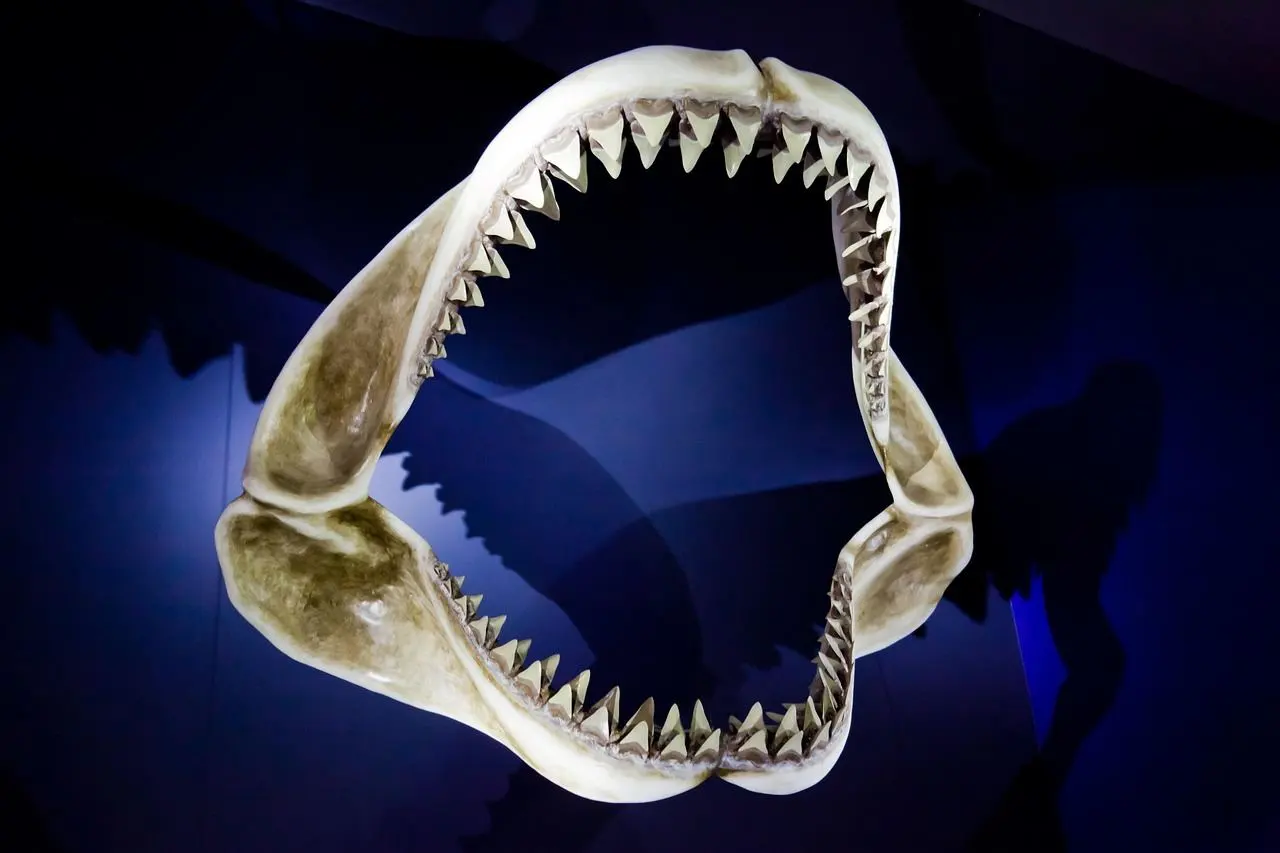
Megalodon (Otodus megalodon) is described as the largest shark that ever lived, according to Pimiento and Clements. Here is what the research says about it:
- Size: it could reach up to 18 m of total length and was a cosmopolitan apex predator that fed on cetaceans (PLoS ONE).
- Time span: it is reported from the middle Miocene to the Pliocene, 15.9-2.6 Ma, in the same paper.
- Reach: its teeth turn up on every continent except Antarctica, a near worldwide distribution (PeerJ).
- Family: it belongs to the Otodus lineage, which ran from the Paleocene to the Pliocene (PeerJ).
Its place at the top of the food chain is why its end matters. Apex predators help keep ecosystems stable, and the Florida Museum of Natural History blog says their removal produces cascading effects across trophic levels.
When did megalodon go extinct?
The answer has moved over time. In 2014, Pimiento and Clements estimated that the species went extinct around 2.6 Ma, in PLoS ONE. A Florida Museum post by Pimiento notes that this date coincides with the Pliocene and Pleistocene boundary.
In 2019, a team led by Robert Boessenecker re-vetted the same worldwide dataset. Their optimal linear estimation gave a median extinction date of 3.51 Ma, and they put the youngest reliable records at the early-late Pliocene boundary, 3.6 Ma, matching the youngest finds in Japan, the North Atlantic and the Mediterranean (PeerJ).
As ScienceDaily’s coverage of that study puts it, genuine fossil occurrences were present until the end of the early Pliocene epoch, 3.6 million years ago. Later fossils either had poor provenance or had been eroded out of older deposits.
How scientists estimate an extinction date
Dating an extinction is hard because the fossil record is incomplete, as the 2014 paper explains. A species can also survive long after the last time it was recorded, which is why the youngest fossil is a poor stand-in for the real date (Florida Museum).
Both research teams used optimal linear estimation, a method that works from the distribution of the most recent records. Because fossils span a range of time instead of one exact date, the 2014 team re-sampled the age of each record 10,000 times, as the Florida Museum post describes.
The 2019 team said that when they checked every occurrence, most dates had problems (ScienceDaily). The problems fell into three groups:
- fossils with dates that were too young or imprecise;
- fossils that had been misidentified;
- old dates that improvements in geology have since refined.
Cooling seas and a new rival
The PeerJ authors suggest that post-middle Miocene oceanographic changes and cooling sea surface temperature may have fragmented megalodon’s range. Competition with the newly evolved great white shark during the Pliocene may then have led to its demise (PubMed record).
Great whites first show up with serrated teeth about 6 million years ago and only in the Pacific. By 4 million years ago they are found worldwide, and the researchers propose that an overlap of 3.6-4 million years ago gave them time to outcompete megalodon (ScienceDaily).
This is a hypothesis, not a proven cause. The same authors also allow that the extinction may have been globally asynchronous, meaning it happened at different times in different regions (PubMed record).
Why the supernova and whale ideas fall short
An earlier study tried to link this extinction, and that of other marine species, with a supernova known to have occurred at about this time (ScienceDaily). Boessenecker said the two events are not immediately related, because megalodon likely died out long before many seals, walruses, sea cows, porpoises, dolphins and whales disappeared about 1-2.5 million years ago.
The 2014 paper also noted a timing match with whales. Modern baleen whales reached giant sizes during the Pleistocene, and the Florida Museum post suggests their ecological role was established once megalodon was gone.
That same post calls this a coincidence and says it does not show cause. The 2019 reanalysis also put the extinction earlier than that boundary, so the neat match no longer holds.
For a comparison with another famous predator, read our explainer on what killed the saber-toothed tiger.
Is megalodon still alive?
The vetted fossil record says no. Reports of Pleistocene teeth do fuel speculation that the shark may still be extant (PubMed record), but the 2014 paper treats such unconfirmed reports as unreliable (PLoS ONE).
In California and Baja California, every occurrence younger than the early Pliocene showed reworking or lacked reliable provenance, which pointed to extinction near 3.6 Ma (PeerJ).
Megalodon is fully extinct, which is a different status from the species we cover in our guide to extinct in the wild animals.
Frequently asked questions
Why do studies give different extinction dates?
Show answer
They vetted the fossils differently. The earlier analysis gave around 2.6 Ma, while the later reanalysis excluded several dubious records and produced a median extinction date of 3.51 Ma (PeerJ). New finds or re-dating could shift the number again.
Did a supernova kill megalodon?
Show answer
The 2019 authors do not think so. They say a period of faunal turnover is more plausible than a sudden catastrophe caused by an astronomical event (ScienceDaily).
Did great white sharks wipe out megalodon?
Show answer
It remains a proposal. The researchers list cooling seas and a fragmented range next to rivalry with the great white, so more than one pressure may have mattered (PubMed record).
Why study the megalodon extinction at all?
Show answer
Large sharks are significantly declining in modern oceans, and the 2014 authors argue that an ancient apex-predator loss offers a deep-time view for conservation (PLoS ONE).