Wondering whether the news you saw about western black rhino extinction is real? It is, but it is old: the IUCN declared this African subspecies extinct after poaching erased the last survivors.
This page is part of our guide to extinct animals, which follows species lost in recent history.
| Item | Value |
|---|---|
| Declared extinct by the IUCN | 10 November 2011 |
| Confirmed survivors in the 2001 survey | 5 rhinos |
| Range left in 1980 | 2 countries |
| Black rhinos killed by poachers, 1960 to 1995 | 98 percent |
| Field surveys by Symbiose in 2006 | 46 field surveys |
The figures come from Guinness World Records and Scientific American. Counts and dates can change as sources are revised, so check the source before you rely on them.
What was the western black rhino?
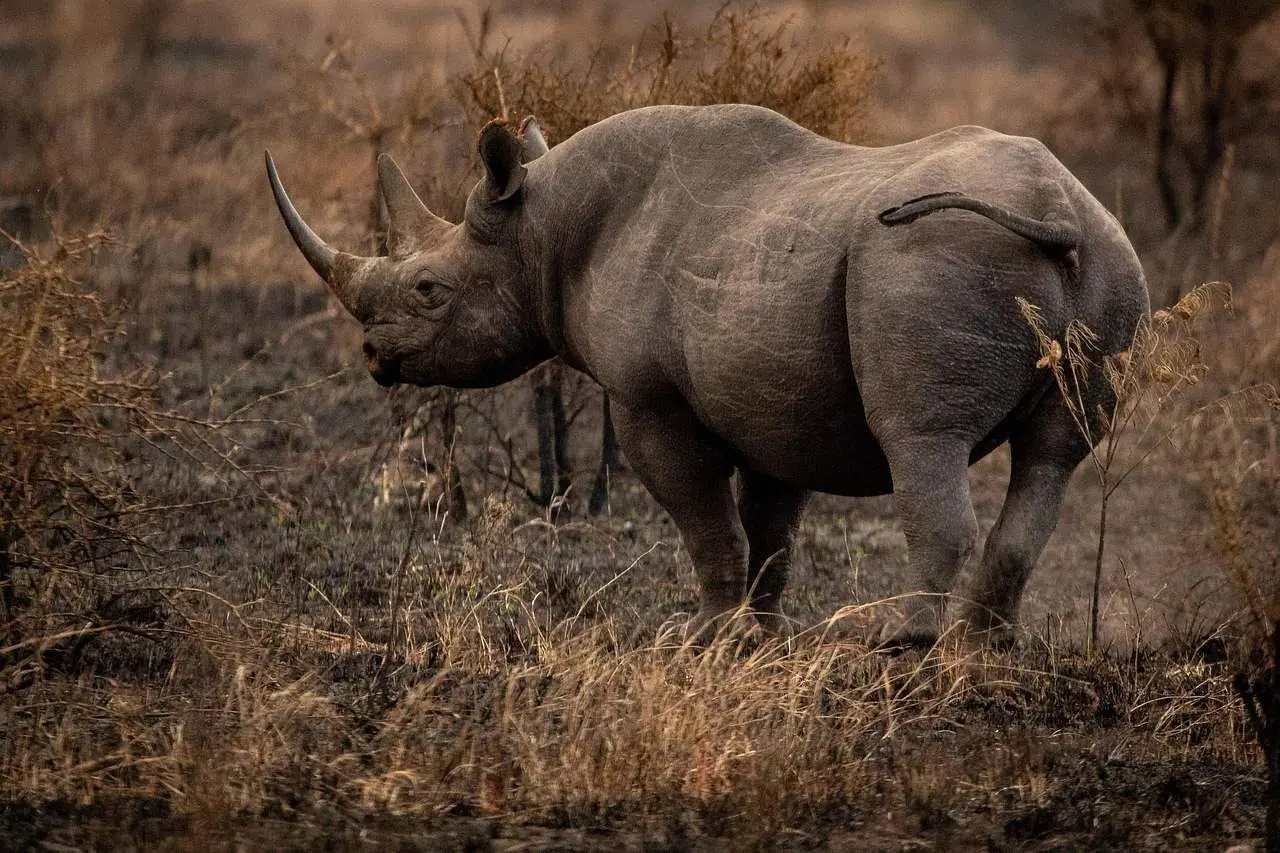
The western black rhino (Diceros bicornis longipes) was a subspecies of black rhinoceros, named by Ludwig Zukowsky in 1949, according to Wikipedia. Like all black rhinos, it browsed leafy plants and shoots.
Historically it ranged across central and western Africa, with populations in modern-day Cameroon, Chad, the Central African Republic, Sudan and South Sudan. That made it the northernmost African rhino subspecies, as Scientific American describes it.
The wider picture is stark. At the beginning of the 20th century an estimated one million black rhinoceroses from four subspecies roamed Africa’s savannas, and by 2001 only about 2,300 black rhinos and three subspecies remained, Scientific American reports.
How hunting, farming and the horn trade drove the decline
Widespread sports hunting in the first decades of the century quickly decimated rhino populations, and industrial agriculture then cleared habitat for fields and settlements. Scientific American adds that farmers and ranchers viewed large herbivores such as rhinos as pests and dangers to their crops.
The horn trade came next. In the early 1950s Mao Zedong promoted traditional Chinese medicine, and between 1960 and 1995 some 98 percent of black rhinos were killed by poachers, per Scientific American.
The medical claims behind that demand are weak. NBC News reported in November 2011 that scientists say there is no evidence to support the rumored cancer-curing power of rhino horn.
The western subspecies fell in steps, according to Scientific American:
- 1980: the range had shrunk to two countries, with 110 animals in Cameroon and 25 animals in Chad (Scientific American).
- Chad’s western black rhinos were wiped out within 10 years (Scientific American).
- 1991: Cameroon held an estimated 50 western black rhinos, dropping to 35 just a year later (Scientific American).
- 1997: the population had fallen to an estimated 10 final rhinos (Scientific American).
Even that count hides how fragile the end was. The 10 last western black rhinos were scattered across 25,000 square kilometers of northern Cameroon, and the six living in isolation averaged 60 kilometers between each animal, according to Scientific American.
The last searches: from a doomed plan to empty patrols
In 1999 the WWF published a conservation plan whose authors wrote that the subspecies seemed doomed unless the scattered animals were captured and concentrated in one area. A WWF survey in 2001 then found just five surviving animals, with the possibility of three more unconfirmed ones (Scientific American).
Gathering the animals was hardly practical. The same plan noted that safe habitat for just 20 rhinos would need a fenced sanctuary of 400 square kilometers, according to Scientific American.
A false hope followed in 2004, when Symbiose reported evidence of as many as 31 western black rhinos in Cameroon. The evidence was quickly discredited because trackers had faked footprints to save their jobs (Scientific American).
In 2006 Symbiose returned for 46 field surveys, according to Scientific American. Wikipedia puts the patrol effort at 2,500 kilometres, with no sign of rhino presence.
The teams also found snares, poisoned waterholes and poaching pressure 2.22 times higher in the area classed as a national park than in official trophy-hunting zones. A paper published in Pachyderm after those surveys concluded that the last members had been poached in or around 2003 (Scientific American).
Why was it declared extinct years after the last sighting?
The recommendation to list the subspecies as extinct was made in 2006, but the Red List always waits five years before changing a status, in case new evidence emerges, Save the Rhino explains. The IUCN’s announcement was reported on 10 November 2011 by CBC.
Sources disagree on the final sighting. Guinness World Records says the animal was last seen in Cameroon in 2006, Save the Rhino puts the last reported sightings in 2003, and Scientific American says the 2001 survey was the last time scientists or conservationists saw one.
The story also keeps resurfacing. Save the Rhino noted in 2013 that CNN and other outlets had recently run the news as if it were fresh, and Snopes found that social media users were still lamenting it in April 2015.
What the loss tells us about other rhinos
In the same November 2011 update, the IUCN described the northern white rhino as “possibly extinct” in the wild and the Javan rhino as “probably extinct” in Vietnam, after poachers killed the last animal there in 2010, per NBC News. Our guide to extinct in the wild animals covers the related category of species that survive only under human care.
The IUCN’s Simon Stuart said in 2011 that for both the western black and northern white rhinos the outcome “could have had very different results if the suggested conservation measures had been implemented” (NBC News). That is the avoidable part of this story.
Recovery is possible. The southern white rhino numbered just 100 animals at the end of the 19th century and, as of the IUCN’s November 2011 update, had grown to over 20,000, CBC reports.
For a contrast from deep prehistory, read about what killed the saber-toothed tiger.
Frequently asked questions
Is the western black rhino really extinct?
Show answer
Yes. The IUCN declared it extinct in 2011, and Guinness World Records lists it as the most recently extinct rhinoceros.
What caused it to disappear?
Show answer
Mostly poaching for the horn, layered on earlier sport hunting and habitat clearance. Wikipedia notes that a widespread belief in the horn’s medicinal value drove heavy poaching.
Could it ever be brought back?
Show answer
Guinness World Records states that there are no known specimens in captivity. With no living animals to breed from, none of the sources here describe a revival route for this subspecies.
Which black rhino subspecies are still alive?
Show answer
As of Save the Rhino’s November 2013 post, three remain: the eastern, the south-central and the south-western, according to Save the Rhino.